
When Giants Sleep
WHEN GIANTS SLEEP
A living tribute to Ruby – chosen family, science, and a life lived without apology.
When giants sleep, you don’t just notice their absence – you notice how much of the world they held up.
Ruby has been one of those giants in my life: intimidating, brilliant, stubborn, fiercely kind, and utterly committed to science and the living world. As she is approaching the final pages of her story, I realize I don’t want to speak about endings until I’ve honoured the magnitude of her presence – and what she has meant not only to me, but to so many people whose lives she shaped.
First, a Clarification
Ruby is not my godmother.
That label was always the easiest shorthand for someone who has been foundationally critical to my life: a mentor, a saviour, an additional parent in many ways, and a distinct source of inspiration. But there has never been anything religious about our bond.
In fact, Ruby was one of the staunchest supporters of Darwin’s theory of evolution I have ever known – steadfast in her support for science, research, and education, and yes – a rather fatalistic belief that if we just deleted humans, we wouldn’t have such tremendous damage done to this planet. She could be brutally blunt about it. The kind of blunt that makes you laugh, pause, reflect, and then feel slightly guilty for existing.
Yet, for someone who believed – quite stoically – that reducing the human population was essential to the planet’s survival, Ruby played one of the most motherly roles in my life.
Anyone who knows me could attest that my own mother was a powerhouse. Ruby would be the second most influential person in my life. Different energy, different type of strength, but just as formative.
Known Me Since I Was Hatched

When I was born – or, as Ruby much preferred – when I was hatched, she was the first non-related person I met.
She didn’t arrive with a small gift and a polite smile. Ruby arrived not only with congratulations for my parents, but with four hand-crocheted baby outfits, each with matching jumpers, toques (ok – she was American… so beanies), and booties.
Four.
Made with impossibly delicate care.
I still have those outfits to this day. It isn’t lost on me that someone without a family obligation would have those outfits ready to go. Even as a child, I wondered: was there a deeper meaning behind that?
Ruby was mesmerizing to me, and over time I came to understand the deeper meaning behind the way she showed love.
The Invertebrate Era

Ruby was a biology instructor who specialized in invertebrates; and if you knew Ruby, that specialization made perfect sense. What always amazed me, though, is how she got there. In old family photos, Ruby looks like she came from a world of poise and polish: perfect dresses, bows in her hair, and the kind of “proper” family posture that makes a child look like a porcelain doll. How that Ruby grew into her Invertebrates Era – devoted to creatures most people are trained to fear or squash – is one of life’s great mysteries.

She handled and collected creatures with ease, from her two parrots (King Tut – a Blue-and-Gold Macaw, and Christian – a Ruby-cheeked Amazon), to her Siamese cats (always in pairs… always Siamese), to her beloved insect residents: Madagascar hissing cockroaches, stick insects, and giant millipedes.

It would not be unusual to open Ruby and Jack’s refrigerator and find a dead animal ready for inspection or dissection – something the cats had brought in ranging from ducks to dragonflies, or paying homage to the end of life to one of Ruby’s bugs. To anyone unprepared for what they might find, this could cause a full-body startle. To Ruby, she thought you had a serious problem if you had any reaction other than amazement at the natural world.

Ruby was one of the people who helped establish the animal collection at Camosun College, ranging from snakes and tortoises, tarantulas and scorpions, lizards, mice, hamsters, guinea pigs, rats, insects – both for education purposes and for snacks. Some of these things were on display. Others were literally food for what was on display – whether for animals or humans.
Dinner Parties, Displays, and Questionable Soup
Over the years, Ruby and Jack hosted elaborate dinner parties with grandiose displays.
As a child, I was once able to peek at what appeared to be an elaborate banquet awaiting the first guests. Upon closer inspection, not only was the menu entirely steeped in invertebrate delicacies (I vaguely recall chocolate-coated grasshoppers and stir-fried mealworms), but the centrepiece of the event gave pause for reflection.
A giant “man eating” clam shell, with the arms of a huge Pycnopodia helianthoides (Sunflower Sea Star) artistically draped over the edge, filled with a unique invertebrate seafood soup.
It defined the affair as truly one of a kind. One that was later discontinued after some guests reported a tingling in their lips and gums.
As Ruby and Jack regularly lament: “oh, those were the good days.”
Cockroach on Ice
Once, there was a blockage in the ice machine at Camosun College – the one producing “clean, filtered” ice for research experiments and preserving plant specimens and materials for class demonstrations.

It turned out the blockage was one of Ruby’s missing Madagascar hissing cockroaches; somehow stuck between the filter and the hose into the ice trays.
This left my mother in hysterics, especially after a fellow instructor had boldly claimed that she only drank water melted from the ice rather than from the tap – because it was “cleaner” and tasted so much better.
Ruby, of course, responded with a stern look and a slight smirk – a brief crack in her otherwise steely exterior – her own way of showing that she too likely found it amusing.
The Iron Lady of Biology
Ruby was often called the Iron Lady of Biology – a presence so intimidating that most people meeting her for the first time would wonder if they could survive her course, never mind pass it.
Many learned that once you moved beyond ‘the look’, this was the façade of one of the most caring, endearing people you’ll ever meet in your life.
Or you should be truly terrified, because you had done something incredibly stupid – and you were about to hear about it in full force.
Honestly, you never know.
The person who played this game of roulette more than anyone else was her husband of 65 years (and counting), Jack.
While my mom chaired the Biology Department at Camosun College, she would dread coming into her office each morning to find Ruby’s scathing list on her desk – usually placed there hours earlier when Ruby arrived at the crack of dawn – outlining all the problems that had to be addressed with urgency. Budget cuts were negotiable. Educational standards were not. Ruby just funded what she needed herself.
There were times lab techs – the backbone of making things happen in the Biology Department at Camosun – were exasperated by Ruby’s expectations: the moon and back, always. Ruby wanted to give her students every possible hands-on learning experience with whatever animals were available – living, preserved, or ready for dissection.
I would often spend hours in the biology lunchroom and animal room (they were one in the same) while growing up – usually tucked in the corner playing with the lizards, tortoises and hamsters, or reading a book while my Mom taught courses on weekends and evenings. Out of sight and out of mind from the biology staff.
I witnessed shocking, snarling discussions between Ruby and others when they could not live up to her standards.
I also witnessed Ruby holding those same people through their darkest days: when a child had been injured, when grief sat like a boulder in their lives, and when a heart broke beyond repair.
That range shows the truth of who Ruby was: someone who demanded excellence, but who carried profound empathy in times of need – an empathy I believe she offered because she knew sadness intimately herself. I feel privileged that she trusted me enough to share that deeper truth with me in the later years of her life.
Teaching Legacy
Ruby didn’t just teach biology – she forged biologists for life, even if that meant you grew up to become an accountant. You may play with numbers during the day and be attached to binoculars looking at birds or digging in gardens on weekends.
There are countless students who still speak about her with a mix of awe, terror, and deep gratitude – not only for what she taught them academically, but for what she demanded of them as human beings: curiosity, discipline, and respect for the living world.
Ruby didn’t tolerate laziness, excuses, or performative interest, and somehow that made people rise.
Through her support, she helped students find their footing, pursue further education, and achieve incredible success. Even now, she still receives Christmas cards from all over – including from one of the very first students she ever taught while teaching high school in Palo Alto, California (right next to Stanford).
That alone tells you everything: you don’t forget Ruby.
The world is full of people who are smarter, braver, and more capable because Ruby once stood at the front of a classroom and refused to accept mediocrity.
I am only one of many who were lucky enough to be shaped by her, despite never being one of her students.
Being Raised without Raising Me
When I was a child, Ruby actively encouraged my love of animals and science. She bought me a membership to the San Diego Zoo long before my first visit with family when I was seven, which she maintained for years and gave me opportunity for several more visits whenever I was in town for work or fun.
She subscribed me to Owl and Chickadee magazines, and I waited eagerly for each edition to arrive. I feel nostalgic whenever I see modern versions of these splayed in the waiting room of my dentist’s office.
She initiated my membership to the Sheldrick Wildlife Trust in Kenya – raising orphaned baby elephants and rhinos and reintegrating them to the wild. Over 35 years later, I still hold my Sheldrick membership today. Because Ruby turned me into a long-time patron, I’ve had the privilege of visiting their Nairobi elephant nursery several times for behind-the-scenes experiences that changed my life – as you would expect when a baby trunk sucks onto your nose and blows. Some people would find this disgusting and ask “why.” Ruby would just say: “Why not?”
Because I was enthralled with all things related to nature and life, Ruby also supported my cat obsession. As my collection of cat figurines and posters grew, until every square inch of my room was covered in cat things, she continued to buy me more. Our love of cats (of all sizes) cemented our relationship from the very beginning.
When I realized that a room covered in cats was perhaps not the most “mature” look for a teenager, my focus began shifting to the ocean and what lies beneath.
My addiction to diving was an incredible outlet – sometimes for Ruby and Jack to divest themselves of “ancient” (’60s and ’70s) dive equipment cluttering up their garage. More importantly, I was an outlet to share some of the most incredible treasures they had collected from the sea over the years.
My first dive off Ruby and Jack’s home at Ten Mile Point was in 1989, and I’ve done hundreds of dives there since. I challenge anyone who says it isn’t the best shore diving spot in British Columbia.
I would gear up in the driveway, with Ruby always asking me, “What are you going to see today?”
She was a constant lighthouse of safety – both as a shore-based point of reference when we came up from the dive, and as someone who always checked in to ensure we were back on land after a reasonable time. I was always reminded of the one time that someone from Alberta died while diving off the point – a $25 death because they didn’t drop their weight belt in an emergency. I never corrected that lead is worth much more today ($10/lb); it's the messaging that was important.
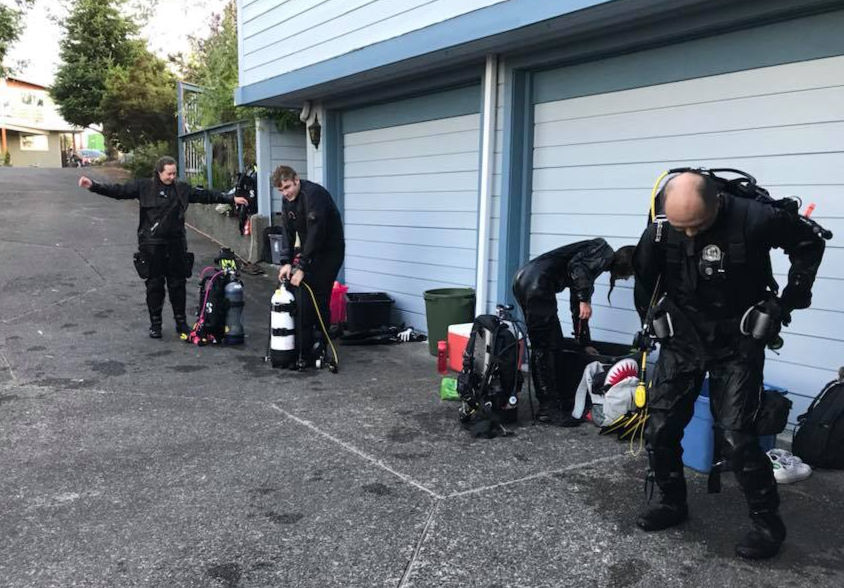
She would always join us afterwards as we rinsed off under the hose asking what we had seen, and sharing in the excitement of my fellow divers and later my dive students as they squealed over the tiniest of finds: a decorated warbonnet (Chirolophis decoratus), a butterfly crab (Cryptolithodes typicus), or bright swaths of bioluminescence caused by marine plankton (Dinoflagellata) on our night dives.
When my interests didn’t exactly make me the popular kid in school – in any shape, way, or form – and I told Ruby I didn’t feel normal, she didn’t laugh. She earnestly asked me why I would ever want to be normal.
Ruby was the first person who made me feel comfortable in my own skin.
A Cat Cures Anything
When I was fifteen, life became complicated in ways I didn’t yet have words for. Ruby and my mom made sure I always had somewhere steady to land, and at times Ruby and Jack’s home became my second home – sometimes my primary one as well.
In the worst moments of my life, I could call Ruby and ask for help. She didn’t ask for details. She simply said: the door is open and your room is ready. Have a shower. Go to bed. We’ll make a plan in the morning. Watch out in case the cat threw-up on the floor.
When I lost my first cat that I adopted on my own, Ruby consoled me – and then told me to go to the SPCA to get two more, because in her mind this was the best way to get over heartbreak.
I was offended.
But damn it - it worked.
Ruby encouraged me to travel the world and see everything I could while I still could. She didn’t just send postcards from her travels; she expected postcards from mine.
She taught me to seek out the rare, the unique, and the fascinating – not just the boring tourist version of life.
That encouragement led me to jungles in the Amazon, diving with great white sharks off Mexico, searching for the horned rhinoceros beetle in Australia, seeing the shimmering blue tarantula in Sri Lanka, witnessing immense fossilized ocean corals locked into the sheer walls of the Nahanni River, and seeing the big cats in the wild in Africa.
Darwin, Diving, and One of the Best Days of My Life
Ruby’s love of Darwin wasn’t casual – it was practically ceremonial. She celebrated Darwin’s birthday annually with the kind of conviction most people reserve for national holidays.
I can say something that still feels impossible: I had one of the best single days of my entire life because of her. Actually, it was because of one of her postcards.
Through Ruby’s influence and my own love of diving, I led a scuba diving trip to the Galápagos Islands – to dive off Wolf and Darwin Islands specifically. It truly was the trip of a lifetime, but what impacted me just as deeply was stepping into the world that shaped Darwin’s thinking.
Visiting the Darwin Research facility and seeing the flora, fauna, and geology in person – the living evidence behind ideas that changed the world – was mind-blowing. We watched the finches – Darwin’s muse – with tiny bands around their feet, tracked and studied for the features that enhanced survival. Standing there, watching it all with my own eyes, felt like looking straight into the engine room of evolution.
Then came Bartolomé Island.

We took a boat ride out, hiked up to the highest caldera, and suddenly I was looking down at the exact view from Ruby’s postcard – except it was real. Distinguishable flows of lava shaped the landscape like art. Penguins sunned themselves on the rocks. Manta rays circled in the water below. Hundreds of dolphins moved through the sea like a living tsunami. And on the walk back to the boat, a grumpy sea lion blocked our path like it owned the entire island – because of course it did.
That day didn’t just feel like travel. It felt like Ruby – like being entrusted with wonder.
Bird Rescues, Journal Articles, and Showing Up
Over the years, Ruby sent me various journal articles – she was always up on the latest research and important discoveries.
She helped me land a random animal care assistant job at a wild animal park – where I raised tiger cubs (long before Tiger King made me realize some parts of that world were truly unhinged), handled snakes that were definitely longer than me, bathed camels and bison, and raised chinchillas before they became common pets.
When I opened a dive store in Victoria, Ruby was fiercely proud. She even collected articles about my diving – achievements I had forgotten – papers I later found tucked away in her files, kept because she thought they mattered.
Because of the experience I had with Ruby’s birds growing up, when the call came for volunteers to help rescue hundreds of exotic birds following the downfall of the World Parrot Rescue in Coombs, BC, I didn’t even hesitate to step up – especially as Ruby coached me the entire way.
When one little fellow, after weeks of rehab, chose me as his person, Ruby happily provided a reference about my commitment to the animals in my household. Whenever I moved, their forever home moved with me. I’ve now had a rescue parrot (or two) ever since.
Interesting Times
Ruby checked in on me daily when I was sick – always asking for updates, always inviting me for dinner to make sure I was eating enough.
Throughout COVID, Ruby and Jack were part of my bubble. Several times a week, we shared 5-star meals (thanks to Jack’s cooking) and deep intellectual conversation.
In a world that felt unstable and frightening, Ruby provided something steady: perspective, curiosity, and a reminder that life should be studied, not merely survived.
She also quoted her favourite Chinese curse: “May you live in interesting times.”
Gardens and Community

When Ruby retired, she shifted her world away from invertebrates and toward gardens and green spaces.
She became Board President of the Horticulture Centre of the Pacific (HCP), and made considerable contributions over decades – becoming a dedicated volunteer until her decline in health kept her away from the gardens.
Ruby was also a regular at exercise classes and places like Curves. To this day, some of the amazing women she met still maintain a monthly routine of coming for tea – a steady rotation of people showing up and reminding Ruby just how appreciated and loved she is.
One story that I’ve heard shared about Ruby: “When new people would show up to Curves, we would introduce them to the regulars. We always said, ‘That’s Ruby. Don’t use the equipment beside her, but beyond this you’ll be fine – and she’s the most amazing person you’ll ever meet.’”
Despite her formidable, intimidating persona, it is amazing how she forged lasting friendships and found communities wherever she went.
A Giant Reader
Throughout it all, Ruby was the kind of person who lived among books.

Her love of reading was legendary, and her book collection is astounding (especially as the person now attempting to catalogue it all as best as I can). Her reading life took her to conferences and author events for the latest murder mysteries, thrillers, and more – a particular focus that always made me wonder what exactly she was studying.
But the other major concentration in her library tells the deeper truth: nature, natural history, non-fiction, and reference books. Many of these books are genuine treasures.
Like everything Ruby did, it wasn’t passive or idle. Ruby didn’t just consume knowledge – she collected it like it mattered, and she treated books like tools for living.
Opening Doors
At one point in my own life, when I wasn’t sure what to do next, Ruby forwarded me an email she had received through the newsletter of her alma mater: Stanford University. It described an early opportunity to get involved in a professional education program through MIT in Boston (actually found across the river in Cambridge, MA, but I didn’t want this to be mistaken for the UK).
I submitted my application and an essay explaining why I would be a suitable candidate to earn my Chief Sustainability Officer certification, focusing on the development of large capital sustainable infrastructure systems and a biomimicry-based system for environmental remediation using mycelium.
I was not only accepted – I won a scholarship to support my studies.
That moment opened doors in my life that I would not have found my way to without Ruby’s encouragement. She was equally proud of me for persevering – even though I lost my Mom only months into the start of my program.
Gifts with Weight
The relationship I’ve held with Ruby has been incredibly special – and nearly impossible to describe. Again, “Godmother” never fully captured it, but it was the simplest word others could understand.
At times, I’ve learned just as much from her insolence as her inspiration. In the late 1980s, when ‘finding your colours’ was a big thing, I remember Ruby learned that she looked better in winter colours rather than fall. Everyone thought she was joking when she said she’d have to replace her mink coat with a silver fox fur instead.
She was not.
For my 30th birthday, Ruby and Jack gave me a huge green sea turtle shell – one estimated to have been over 100 years old and found after local turtle fishermen had finished a day’s work on the beaches of Bahía de los Ángeles, Baja Peninsula, Mexico (before it was illegal). Ruby and Jack had kept the shell and brought it with them to Canada. She did always say that turtle soup was delicious. I’ll thankfully never know.

For my 40th, they gave me a 1.4-metre sawfish blade – a specimen of Ruby and Jack's from their invertebrate collection while studying at Stanford University. The largest blade on a living sawfish that I’ve ever seen while diving was about 0.14m – max.
In recent years, I’ve been helping sort through a house that’s more like Indiana Jones’ office after Ruby and Jack’s adventures all over the world: random finds like a bottle of Shackleton’s finest from Antarctica, pictures of Welwitschia mirabilis (Namibia’s national plant, found only in the country’s deserts), a fur hat and gloves from Russia, team shirts representing soccer teams from Brazil, and extremely fine petit-point needlework on silk screens from China.
As I moved aside the pith helmets, framed specimens, and boxes of surprises, I found something Ruby had often alluded might be my 50th birthday gift.
We had celebrated my birthday together for years, but my husband had taken me off on another adventure to celebrate my half-century milestone. With Ruby’s declining health, my birthday was understandably not on the radar.
Remember the clam shell used for serving starfish soup? I awkwardly carried the thing upstairs and somewhat humbly asked Jack if I could keep it. I then struggled to lift it up so Ruby could see it, and confirm it was okay for me to have. I was giddy with excitement at hearing its origin story as much as the clam itself.

The giant “man eating” clam shell – collected sometime in the 1950-1960s during a Vanderbilt-funded / Stanford University expedition off Runit Island (Enewetak), now the site of “The Tomb,” the concrete dome covering radioactive waste in the South Pacific. One of the expedition’s intention had been to collect and inventory species before and after nuclear testing began in the late 1940s and early 1950s, to study impacts over time. The shell ended up in Ruby and Jack's invertebrate collection from Stanford, making its way to Canada in the mid 60s.
Also – before you ask if I’m glowing green – this sample would have been taken far away from or before nuclear testing began – or at least I hope so. Now that I think of it, maybe this is why people’s lips were tingling when eating the soup. (I'm kidding).
These are gifts that are awe-inspiring and sobering all at once – once-magnificent evidence of creatures that roamed the earth in greater size and abundance than we see today. (I guess giant clams didn’t roam, but “magnificent filter-feeders” didn’t have the same ring to it.)
These aren’t easy objects to display. They’re like being given an elephant tusk. They don’t sit lightly in a home.
But I’ve always had a plan to use them for education. To turn their weight (metaphorical and physical; the clam shell weighs nearly 50 lbs, making it the perfect 50th birthday gift) into knowledge – another example of how Ruby’s influence shaped my dedication to teaching and making the world a better place.
Preferably, as Ruby would say, with fewer humans around to ruin it.
The Final Chapter
As Ruby comes to the end of her life, many have been surprised at my devotion to supporting her.
There have been times – with her declining health – where I have witnessed loss of dignity I never wanted for her, nor would she have wanted for anyone else. I've mustered through helping her, then went to bed in tears on many nights. But my goal has always been to offer her grace in a time where she has shown extraordinary strength facing the later chapters of her life.
It has been an honour.
At times, a horror.
But always a privilege.
To offer support in lieu of a daughter.
For Ruby to tell me, over and over, that I’m the daughter she never had – that is something I will carry forever.
Ruby may not be my godmother, but she is family.
As Ruby enters her final chapter, I will continue to show up for her the way she has shown up for me – with steadiness, loyalty, and love that doesn’t require explanation.
Because when giants sleep, we don’t just mourn the quiet.
We honour what they held up – and we try, in our own imperfect way, to keep carrying it forward. Even if that means becoming an engineer instead of a biologist.


Comments